- Türkçe
- English
- 简体中文
Knowledge and Wisdom in Comparative Perspective
Thursday, 21 November 2013
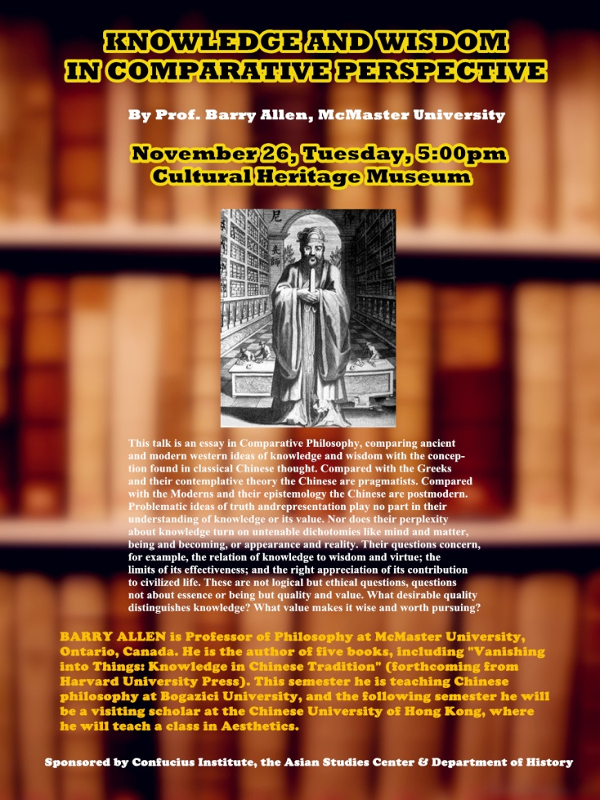
KNOWLEDGE AND WISDOM IN COMPARATIVE PERSPECTIVE By Prof. Barry Allen, McMaster University November 26, Tuesday, 5:00pm Cultural Heritage Museum This talk is an essay in Comparative Philosophy, comparing ancient and modern western ideas of knowledge and wisdom with the conception found in classical Chinese thought. Compared with the Greeks and their contemplative theory the Chinese are pragmatists. Compared with the Moderns and their epistemology the Chinese are postmodern. Problematic ideas of truth and representation play no part in their understanding of knowledge or its value. Nor does their perplexity about knowledge turn on untenable dichotomies like mind and matter, being and becoming, or appearance and reality. Their questions concern, for example, the relation of knowledge to wisdom and virtue; the limits of its effectiveness; and the right appreciation of its contribution to civilized life. These are not logical but ethical questions, questions not about essence or being but quality and value. What desirable quality distinguishes knowledge? What value makes it wise and worth pursuing? BARRY ALLEN is Professor of Philosophy at McMaster University, Ontario, Canada. He is the author of five books, including "Vanishing into Things: Knowledge in Chinese Tradition" (forthcoming from Harvard University Press). This semester he is teaching Chinese philosophy at Bogazici University, and the following semester he will be a visiting scholar at the Chinese University of Hong Kong, where he will teach a class in Aesthetics. Sponsored by Confucius Institute, the Asian Studies Center & Department of History
Son Güncelleme: 16:51:04 - 25.04.2024